Showing posts with label Nigeria. Show all posts

Sunday, November 17, 2013

Eyes on Nigeria: Human Rights Supplement to Transwonderland


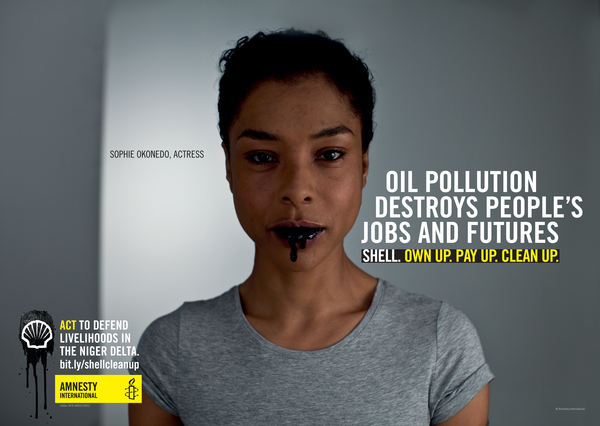
This month we are travelling to Nigeria via Noo Saro-Wiwa's Looking for Transwonderland. While we are on tour, one stop definitely needs to be Amnesty International's Eyes on Nigeria website, particularly the interactive map which documents the location of oil spills, forced evictions, police brutality incidents and more. Also worth checking out are Amnesty's 2011 report The True 'Tragedy': Delays and Failures in Tackling Oil Spills in the Niger Delta and a press release from this month: Shell’s false claims on Niger Delta oil spills exposed,
A new report published today uncovers specific cases in which Shell has wrongly reported the cause of oil spills, the volume of oil spilled, or the extent and adequacy of clean up measures.

"Shell is being disingenuous about the devastation caused by its Niger Delta operations. This new evidence shows that Shell's claims about the oil spills cannot be trusted," said Audrey Gaughran, Director of Global Issues at Amnesty International.

New analysis from an independent expert found that so-called official investigation reports into the cause of oil spills in the Niger Delta can be "very subjective, misleading and downright false."

The report highlights systemic weaknesses in the way the cause of a spill and the volume are determined - with some significant errors in the volumes that are recorded as spilled.

The consequences for the affected communities are devastating and can result in them receiving little or no compensation.
Another important report regarding forced evictions was released this past August: If You Love You Life, Move Out! NIGERIA: Forced Eviction in Badia East, Lagos State,
By the end of the demolition, the Oke Ilu-Eri community, which forms part of Badia East, was razed to the ground and a part of the nearby Ajeromi community was also destroyed. At least 266 structures that served as homes and businesses were completely wiped out, affecting an estimated 2,237 households. Ataminimum, close to 9,000 people were affected. No alternative housing was provided by the Lagos state government and people were left homeless after the demolitions.
Finally, here is a short documentary about the oil spill issue. It contains a brief appearance by Ken Saro-Wiwa, Jr., Noo's brother.

The Transwonderland Tour


Reading a travel book like Noo Saro-wiwa's Looking for Transwonderland: Travels in Nigeria is time-consuming, not because it's a difficult read but you need to keep a computer handy because you want to look for pictures or videos of the sights she describes. Of course the first thing I wanted to search out was pictures of the decrepit amusement park Transwonderland, but I kept getting directed to the wonderful book cover illustration by Rod Hunt, so that will have to do.

I did find the video above, offering up the fantastically colorful pageantry of the Durbar Festival in Kano. We here at Rights Readers love a parade and this looks every bit as exciting as what Pasadena has on offer with bonus points for the elegantly costumed horses. (You might want to jump ahead 2-3 minutes into the video to avoid a long credit sequence.) A couple of World Heritage sites are mentioned in the book. Here's the UNESCO website for the Sukur Cultural Landscape and the Osun-Osogbo Sacred Grove.

And just to balance the picture with a little modern day reality, check out Transparency International's country profile of Nigeria, where among other fun facts, you'll learn that 63% of Nigerians reported paying a bribe in 2010. I'll share more on human rights concerns in Nigeria in my next post.

Saturday, November 16, 2013

Our November Author: Noo Saro-Wiwa


This month our reading adventure is a road trip with Noo Saro-Wiwa. The short video above lets you get acquainted with the author of Looking for Transwonderland: Travels in Nigeria (and offers an endorsement of another Rights Readers favorite, Michela Wrong). Other brief audio interviews (of better quality than the one above) are available from PRI and the BBC. This Guardian profile might be the best introduction and goes to the heart of the book --beyond travelogue to her journey towards reconciliation with the country where her father, writer and activist Ken Saro-Wiwa, was executed,
Spending time in Nigeria left her deeply, indelibly impressed by her father's achievements, she says. "It's such an incredibly tough country, just to live in. You see how people struggle. The skills you need merely to survive there … It's just so much more difficult than in the UK. So to truly see what my father achieved, from such a disadvantaged background economically and ethnically, and the challenges he took on over and above that – facing down a massive oil multinational, a military dictatorship. I knew he was brave, but only now do I really understand just how monumental it was, what he did."
One reason we wanted to read Noo's book was because we had so much enjoyed her brother Ken's very moving book, In the Shadow of a Saint: A Son's Journey to Understand His Father's Legacy. It's one of my all-time favorite Rights Readers selections. If you picked up Transwonderland and want to go deeper it's worth tracking down,
What was it like to grow up with such a politically active and socially conscious father? How do you come to terms with your father's imprisonment and execution? How do you cope with the endless international press speculation about your father's life and character? And how do you respond when international attention is focused on you? How do you make your own way in life against your father's expectations of you, especially when you carry the same name? How do you live with such a complex personal history? This frank and memorable depiction of Ken Saro-Wiwa's childhood and relationship with his father vividly recounts the journey he took to answer those questions.
Here's an interview with Ken about the book:


I don't want to leave out sister Zina out either. Get to know this young filmmaker at her home page zinasarowiwa.com. Check out some of her short experimental films, try The Deliverance Of Comfort which shares some concerns found in Transwonderland or Phyllis which she describes as "alt-Nollywood."

Definitely a lot of talent in the family (Papa would be proud!) and we're looking forward to keeping an eye on their future projects!

Wednesday, November 13, 2013

Rights Reel: Nollywood Babylon and more


This month we are reading Noo Saro-Wiwa's account of visiting her homeland, Looking for Transwonderland: Travels in Nigeria. As part of soaking in the local ambiance, the author takes in some Nigerian cinema and meets up with a local film director. If you'd like to learn more about Nollywood, the world's third largest film industry, Nollywood Babylon will take you there. This documentary is readily available through Amazon Instant and Netflix streaming. The film is worth it not just for insights into modern Nigerian storytelling and entrepreneurship, but also the glimpses it gives of Lagos' vibrant street life. The relationship between the film industry and evangelical Christianity is also explored.

While we are revisiting the Saro-Wiwa legacy, there are two other films available via Amazon and Netflix that Loyal Readers may be interested in. One is the documentary Delta Boys which investigates the stories of anti-government rebels in the oil-rich Niger Delta. The other is a BBC mini-series Blood & Oil. It's not the BBC's finest hour, but the drama features a young, naive Nigerian ex-pat woman, the daughter of a prominent judge, who returns to Nigeria after rebels have kidnapped some British oil workers, so it's an interesting companion to Transwonderland.  Plus, I'm always interested in how human rights issues get processed through popular culture. Fair warning though, if you are sensitive to on-screen violence, you should proceed with caution with both these films.

Monday, August 05, 2013

For November: Looking for Transwonderland by Noo Saro-Wiwa

Several years ago, we read Ken Wiwa's memoir, In the Shadow of a Saint, a memoir about his relationship with his father, the writer and activist Ken Saro-Wiwa who was executed by the Nigeria government in November 1995. The book was one of our favorites. Now our Pasadena group has chosen a book for this coming November by his daughter Noo: Looking for Transwonderland: Travels in Nigeria. I'm really looking forward to Noo as our guide to life in contemporary Nigeria.
Noo Saro-Wiwa was brought up in England, but every summer she was dragged back to visit her father in Nigeria — a country she viewed as an annoying parallel universe where she had to relinquish all her creature comforts and sense of individuality. After her father, activist Ken Saro-Wiwa, was killed there, she didn’t return for several years. Recently, she decided to come to terms with the country her father given his life for. 
Saro-Wiwa travels from the exuberant chaos of Lagos to the calm beauty of the eastern mountains; from the eccentricity of a Nigerian dog show to the decrepit kitsch of the Transwonderland Amusement Park. She explores Nigerian Christianity, delves into the country’s history of slavery, examines the corrupting effect of oil, and ponders the huge success of Nollywood. 
She finds the country as exasperating as ever, and frequently despairs at the corruption and inefficiency she encounters. But she also discovers that it si far more beautiful and varied than she had ever imagined, with its captivating thick tropical rainforest and ancient palaces and monuments. Most engagingly of all, she introduces us to the many people she meets, and gives us hilarious insights into the African character, its passion, wit and ingenuity. 

Thursday, May 21, 2009

Wiwa V. Shell

In the Shadow of a Saint: A Son's Journey to Understand His Father's LegacyIn the run up to the Wiwa v. Shell trial set to begin next week in New York, PEN American Center sponsored a panel discussion featuring Ken Wiwa (In the Shadow of a Saint: A Son's Journey to Understand His Father's Legacy). The proceedings are also summarized at Guernica and the NYT,
Among the accusations are that Shell employees were present when two witnesses were offered bribes to testify against Mr. Saro-Wiwa, said Jennie Green, a senior lawyer at the nonprofit Center for Constitutional Rights, which is representing the family. She said Mr. Saro-Wiwa’s brother Owens has also stated that Shell’s managing director, Brian Anderson (now retired), told him, “If you call off the campaign, maybe we can do something for your brother.”
The article also mentions that Ken Wiwa is working on a novel. The NYT explores the implications for other corporations with questionable human rights practices here and the history of oil exploitation in Nigeria here.

In addition to the Center for Constitutional Rights, Earthrights International is involved in the lawsuit. Loyal Readers may remember Earthrights founder Ka Hsaw Wa's visits to Caltech. He weighs in here.

Finally, Democracy Now reports on the latest violence in the Niger delta.

Friday, March 09, 2007

Democracy on Deadline

Last year Independent Lens aired the film Democracy on Deadline: The Global Struggle for an Independent Press which followed several brave and determined journalists as they tried to shine some light on dark places. You can still check out the journalist profiles on the website, including Anna Politkovskaya (Putin's Russia) and Israeli reporter Amira Hass (Rights Readers selection Drinking by the Sea at Gaza) as well as Nigerian Chris Anyanwu, a former prisoner of conscience. The site also has a handy list of links to organization supporting freedom of the press.

And while we are on the subject of courage in journalism, Amnesty International USA announced the award of the Ginetta Sagan Human Rights Award to Mexican reporter Lydia Cacho Ribeiro yesterday.

Monday, February 19, 2007

News from the Niger Delta

Consider this homework in advance of our April Earth Day activities: depressing news from the Niger Delta,

But it was hard to escape the conclusion that it might all be too little too late. There are people of genuine goodwill working for the oil companies, many of whom are determined to find a way to earn that elusive and much talked-about “SLO” (social license to operate) that makes it possible for their employers to work in peace in the Delta. But increasingly, alongside good intentions and innovative approaches to community and media relations, there is also a mood of resignation and gathering despair, a feeling that things may have gone too far, too deep, in a way that no amount of goodwill can turn around. “The Pope himself could not fix things now,” was the way one activist described the situation of the Delta to me. “He would just be corrupted or killed or co-opted by one group or another. Today, every little boy in Nigeria is talking about ‘big money,’ not hard work. People are assassinating one another to become local councillors. How can you turn something like that around?”

The author of this article, John Ghazvinian, has a book coming out which could well be a future Rights Readers selection.

Saturday, January 28, 2006

Senate Resolution introduced for Ken Saro-Wiwa

Senators Leahy, Kennedy, Feingold, Obama, Dodd and Durbin have introduced Senate Resolution 303, calling on the Nigerian government to conduct a thorough judicial review of the Ken Saro-Wiwa case. Visit the Amnesty website for more info and to get your Senators on board.

Thursday, January 26, 2006

Nigeria: Report on Forced Evictions

Last summer we were moved by the description of the Lagos slum demolition which is the climax of Chris Abani's novel, Graceland. Now Amnesty has released a report, Nigeria: Making the destitute homeless - forced evictions in Makoko, Lagos state on just such an incident.

Wednesday, November 16, 2005

Niger Delta in the News

The Los Angeles Times reports on the "combustible" situation in the Niger Delta:

Ten years after Nigerian authorities executed Niger Delta writer and community activist Ken Saro-Wiwa, popular anger and unrest continue to grow, while warnings of a calamitous slide into violence abound. Saro-Wiwa campaigned for a greater share of oil wealth for the population and protested environmental damage, but little progress has been made since his death...

"Unless something drastic is done, there will not be peace around here. There's going to be trouble," prominent human rights activist Anyakwee Nsirimovu said.

With the decline in traditional occupations like fishing and farming because of environmental degradation, many young people are easily recruited into militias or crime cartels, which get their funding from oil "bunkering," or theft...

Ledum Mitee, spokesman for the Movement for the Survival of the Ogoni People, the group Saro-Wiwa founded, accused the company and its contractors of "divide and rule" tactics, bribing certain people or offering contracts to circumvent community opposition and get its work done in the region, which has half a million people and massive oil reserves. Mitee faced trial with Saro-Wiwa and is often seen as his successor.

One community chief in the Ogoni village of Kegbara Dere, Clement Goni Badom, said people were still so opposed to the company that calling someone an agent of Shell was like using a swear word.

The company said in e-mailed answers to questions from The Times that it would only return to the area if welcomed by the community. Despite the anger, the company argued, communities have turned to Shell to address poverty in the region instead of looking to the government. Shell said it had adopted a new approach across the delta region, abolishing ad hoc payments to communities or individuals to get access to sites.

Activist Nsirimovu said Shell's policies were "beautiful on paper. But those standards don't apply here."

Baakpa Birabil, 60, a farmer in Kegbara Dere, is angry that his small plot of land was destroyed in a spill two years ago. "My anger is toward Shell, who just came to my land and exploited it without leaving anything for me. You can see we are very poor people." He said people had expected good things when the oil companies first arrived, decades ago. "We never expected it would bring bad things," he said.

Thursday, November 10, 2005

Memorializing Ken Saro-Wiwa

Today is the tenth anniversary of the execution of Ken Saro-Wiwa. How to commemorate this date? Revisit the other posts on this site about the on-going struggle of Nigerian activists to protect their environment in the face of degradation caused by the oil industry and take the recommended actions. Read Ken Wiwa's piece on his father in the Guardian (also linked on this blog), and let's let Saro-Wiwa the writer speak for himself: Sydney PEN Center has a tribute which includes a couple of his poems plus tribute poems by Ben Okri and Jack Mapanje. I used to read "The True Prison" at the end of every talk I gave for Amnesty/Sierra Club's Just Earth Network. A creation of a memorial poetry collection, Dance the Guns to Silence is part of the international effort to recognize this date, but alas the book appears to have no US publisher at this point.

Finally, how about some thoughts from a Nigerian blogger: Nigerian Times reminds us of the other martyrs to the Ogoni cause.

Thursday, November 03, 2005

Amnesty International Issues New Nigeria Report

Amnesty issued a new report today, Claiming rights and resources: Injustice, oil and violence in Nigeria and accompanying actions targeting the Nigerian, US and UK governments and Shell and Chevron.

Among the abuses in Nigeria, the report details the February 4, 2005 assault on protesters by Nigerian soldiers and Chevron-hired security guards. One person was shot dead, and at least 30 were injured. Neither Chevron nor the hired security forces assisted the medical needs of the injured. Despite video of beatings and independent observers accounts of violence, Chevron has not lived up to its human rights responsibilities. The company denies responsibly, did not investigate the incident, and has not taken essential steps to prevent a recurrence. Check out the link above for more info and to take action.

Thursday, October 20, 2005

Nigeria, Oil and Ken Saro-Wiwa

In November we commemorate the ten year anniversary of the execution of Nigerian author and environmentalist, Ken Saro-Wiwa by reading Ken Wiwa's moving memoir of his father, In the Shadow of a Saint. Here are a few background links:

RememberSaroWiwa is the UK-centric 10-year memorial site for KSW:

Price of Oil is a joint project of Amnesty-USA, PEN, Earthrights Intl and Sierra Club, among others. (I tried to get our discussion listed on the site, but its not showing up, at least not yet.) Be sure to check out the slideshow.

Recent NPR series on oil in Nigeria

Recent National Geographic Articles (check out the related links on these too)
Singing Songs for Freedom
African Oil: Whose Bonanza?
Related Posts Plugin for WordPress, Blogger...