Showing posts with label Michela Wrong. Show all posts

Thursday, August 20, 2009

Rights Readers Round-up

The Complete PersepolisRights Readers authors have been busy this summer:

Iran continues to be a major topic of commentary: check out Marjane Satrapi (Persepolis) in the NYT: I Must Go Home to Iran Again. Azar Nafisi (Reading Lolita in Tehran) calls for freeing filmmaker Maziar Bahari (more from AIUSA and action) Message to Tehran: Let our truth-teller go. Stephen Kinzer (Crescent and Star) is optimistic Iran and U.S. 'not fated to be enemies forever' and offers some advice to Obama on a shared birthday.

On the home front, Barbara Ehrenreich (Nickel and Dimed) has three NYT editorials with audio supplement on the how the recession has hit the "already poor," here, here and here, while Hector Tobar (The Tattooed Soldier) has another insightful column on immigration. Walter Mosley (Little Scarlet) offers 10 Things You Need to Know to Live on the Streets, and has an opinion piece in Newseek: America's Obsession with Crime which he also discusses on NPR.

Tracy Kidder (Mountains Beyond Mountains) pays tribute to a local hero he met while writing his latest book (Strength in What Remains) in the NYT: A Death in Burundi. Edwidge Danticat (Brother, I'm Dying) writes an appreciation of Nobelist Wole Soyinka for the Progressive.

Mark Hertsgaard
(Earth Odyssey) reports from Burkina Faso on climate change and appears on a FORA.tv panel on food security and climate change. Hertsgaard is preparing a book on the subject, certainly a good candidate for a Rights Read. Kevin Bales (Disposable People) is interviewed about his latest book, The Slave Next Door.

As follow up to our discussion of Caroline Elkins, (Imperial Reckoning), check out the Times (London) coverage of efforts by Mau Mau veterans to investigate torture claims, here and here with analysis here and here. Speaking of Kenya, Michela Wrong (I Didn't Do It for You) can be found promoting her new book, It's Our Turn to Eat: The Story of a Kenyan Whistle-Blower at openDemocracy (see also interviews with NPR and NYT.) Her pr strategy has some interesting twists.

Muhammad Yunus (Banker To The Poor) was one of the luminaries who received a presidential medal of freedom. Paul Farmer (Mountains Beyond Mountains) will not be heading USAID, but Samantha Power (A Problem from Hell) has been appointed by President Obama to assist refugees of Iraq war. And did you know that in a nod to the late Russian journalists Anna Politkovskaya (Putin's Russia) and her brave colleagues, President Obama gave an interview in Novaya Gazeta on his recent Moscow visit? More from CPJ. Sister Helen Prejean (Dead Man Walking) has some post-papal audience questions for Obama (and the activist community). Meanwhile Jarvis Jay Masters' (Finding Freedom) latest, That Bird Has My Wings is available for amazon pre-order.

Okay, so I should probably post a little more often so as not to make this such a huge link dump... but at least I'm caught up!

Saturday, March 15, 2008

Our March Author: Wangari Maathai

Before you go any further, visit the Amnesty International USA site to take action on behalf of Wangari Maathai, author of our March selection, Unbowed.

Kenyan human rights defender and Nobel Peace Prize laureate Professor Wangari Maathai received three death threats on her cellular telephone on February 19, 2008, as did two people working for her.

These threats read, ‘‘Because of your opposing the government at all times, Prof Wangari Maathai, we have decided to look for your head very soon, you are number three after Were, take care of your life.” The threats were signed ‘‘Mungiki.” The “number three” refers to the two Members of Parliament who were killed at the end of January.

The website for the Greenbelt Movement does provide some reassurance that Wangari Maathai's security detail was reinstated on March 5. Of course the site is worth exploring to learn more about the movement (pictures!).

There are many Wangari Maathai interviews available on line. This interview is the one that brought Unbowed to my attention, and here's another recent one from Democracy Now. Asked about Iraq,

And in Africa, in particular, I know we have many wars. We have a war in Darfur. We have wars in many other countries like the Congo, in West Africa, in Somalia right now. We are still having these wars. And these wars, when you look at all of them, you realize that they are all about resources. It’s the question of who is going to control the resources in this country, who is going to be included, who is going to be excluded, who is going to be in charge of these resources.

I think that if we would get the message that the Norwegian Nobel Committee gave us in the year 2004, we would sit back and rethink again: Isn’t there another way of managing these resources, of sharing these resources, of being more inclusive, of allowing everybody to play a part to benefit, so that we do not have to fight and kill each other, so that we can have the supreme control of these resources?

Speaking of Faith has an interview and slideshow of Kenyan women (accompanied by Wangari Maathai singing!)

In addition to the Greenbelt Movement's activities, learn more about the United Nations Environmental Programme's "Plant for the Planet" project to plant one billion trees in 2008 here. NPR has a report on how this program is working in Indonesia.

For a taste of Wangari Maathai's inspiration: Mount Kenya is a UNESCO World Heritage site and a photo gallery and video can be found here. PBS Nature has a feature on the fig tree, The Queen of Trees. When I first saw the title, I thought this was a reference to Wangari Maathai herself! Watch a trailer here.

The latest Amnesty reports and actions on Kenya can be found here. Also of interest, another Rights Readers author, Michela Wrong, offers some insight into recent events in Kenya in the New Statesman.

Finally, while there are many Wangari Maathai videos available on YouTube, try this for a taste of her storytelling skills,


Monday, May 21, 2007

Our May Author: Caroline Elkins

As the author the Pulitzer-winning Imperial Reckoning: The Untold Story of Britain's Gulag in Kenya, I expected to find more interviews with Caroline Elkins. For what it's worth here's one from NPR. And here's a profile from the History News Network. This Boston Globe piece has some good quotes,
Elkins said, ``When I was writing, there was a bit of damned-if-you-do, damned-if-you-don't. If you wrote a book like this and didn't have an opinion, people would say, `For God's sake, how can you possibly not have an opinion about this?' But if you express anything that hints at partiality, people will say you're not impartial enough."
and from one of her critics,
Kenyan historian Bethwell Ogot questioned Elkins's honesty in quoting anonymous settlers' confessions of tortures: ``How do we know these are not fabricated confessions intended to paint the British in the worst possible light?" he wrote in The Journal of African History. In a review in the Times of London, historian Lawrence James wrote, ``Like other American academics, [Elkins] is an heir of the [American] war of independence and schooled to believe that all empires are intrinsically evil, corrupting and integral to the `old Europe' of current American demonology. . . . The reputation of the British empire can withstand the defamation of holier-than-thou American academics."
Gotta love those Brits! But they aren't all like that... the New Statesman offers a counter view. Plus they offer a bit of psychoanalysis from Michela Wrong (Rights Readers selection, I Didn't Do It for You : How the World Betrayed a Small African Nation). I must say that the piece made me a bit uncomfortable.

NPR, the Guardian and the BBC (here and here) report on the efforts of the Mau Maus to seek restitution. The BBC report contains a tantalizing sidebar of audio/visual offerings (Terence Gavaghan "I feel no guilt") that don't function for me. Best of luck to those with different computer configurations. Finally, for a sense of how the Mau Mau rebellion was presented to the British public at the time it was happening, check out this YouTube video.

Tuesday, January 30, 2007

Eritrea Update

A must read for our on-going project to bring attention to human rights issues in Eritrea, Michela Wrong (Rights Readers Selection, I Didn't Do It for You : How the World Betrayed a Small African Nation) writes in the New Statesman about the conflicting interests of Eritrea and Ethiopia in the renewed Somalian conflict. [Link]

Tuesday, September 19, 2006

John Le Carre Journeys to Congo

In The Nation, John Le Carre goes to the Congo in search of fictional characters... and one of his guides is Michela Wrong. The NYT reviews Le Carre's latest novel here.

Thursday, September 14, 2006

He Didn't Do It For Them

A final post on Michela Wrong's I Didn't Do It for You (though not our last Eritrea post by any means). Here's a review article of Wrong's book, entitledHe Didn’t Do It for Them, appearing in Middle East Report, written by Eritrea expert Dan Connell, which adds another layer to her analysis of the human rights situation in Eritrea. Also, if you scroll down this page you can hear audio of Connell presenting at an Eritreans for Human and Democratic Rights-UK organized Human Rights Symposium (moderated by... Michela Wrong!).

Tags: ,

Wednesday, September 13, 2006

Language Lesson

Language Geek alert!  I know we weren't going to let this take over the blog until November, but just felt the need to provide a few links on language in Eritrea before wrapping up our Michela Wrong-I Didn't Do It for You  thread.  Here's a map of Eritrean languages and Omniglot has more on Ge'ez and Tigrinya, including links to fonts for download (clean up those messy looking - ??? - Eritrean webpages!).  And in the interests of pure geekiness, Omniglot also has an Interlingua page.  No need to apologize if you don't recall where the book references this.  You're normal.  For those that did perk up at this bit of trivia, I know I'll be hearing shortly from you about the formation of a Tigrinya study group. Rock on.

Tags: ,

Friday, September 01, 2006

Our September Author: Michela Wrong

Here's a Fresh Air interview with Michela Wrong, author of I Didn't Do It for You : How the World Betrayed a Small African Nation.

Wrong also writes a regular column for the New Statesman.  You can check out her views on African issues here.  (Warning!  The New Statesman only lets you read one column per day without a subscription.  And to discourage you more, the article titles are rather opaque.  Worth keeping this in mind though to see her take on any new developments in Eritrea.) 

Tags: ,

Tuesday, August 22, 2006

Intro to Eritrea

As a little incentive for our September book, Michela Wrong's, I Didn't Do It for You : How the World Betrayed a Small African Nation, I offer this gorgeous photoset by photographer Eric Lafforgue. Mostly portraits, some street scenes and a camel or three! For a preview look for the Flickr badge in the sidebar or go directly to a slideshow!

Tags: , ,

Wednesday, August 09, 2006

Estifanos Seyoum, Eritrean Prisoner of Conscience

Group 22 now has a webpage dedicated to our newly adopted Eritrean prisoner of conscience, Estifanos Seyoum.  Please stop by, learn about the case and take action.  The link has also been added to the sidebar of this blog.  New actions and updates will be posted from time to time, so check back frequently.  Consider this a warm-up for our September selection, Michela Wrong's I Didn't Do It for You : How the World Betrayed a Small African Nation.

Tags: ,

Tuesday, June 13, 2006

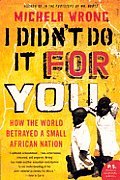
For September: I Didn't Do It for You : How the World Betrayed a Small African Nation

For September we have chosen Michela Wrong's I Didn't Do It for You : How the World Betrayed a Small African Nation. We are looking forward to learning more about Eritrea to better inform us in our campaign on behalf of prisoner of conscience, Estifanos Seyoum.
Scarred by decades of conflict and occupation, the craggy African nation of Eritrea has weathered the world's longest-running guerrilla war. The dogged determination that secured victory against Ethiopia, its giant neighbor, is woven into the national psyche, the product of cynical foreign interventions. Fascist Italy wanted Eritrea as the springboard for a new, racially pure Roman empire; Britain sold off its industry for scrap; the United States needed a base for its state-of-the-art spy station; and the Soviet Union used it as a pawn in a proxy war.

In I Didn't Do It for You, Michela Wrong reveals the breathtaking abuses this tiny nation has suffered and, with a sharp eye for detail and a taste for the incongruous, tells the story of colonialism itself and how international power politics can play havoc with a country's destiny.
Related Posts Plugin for WordPress, Blogger...