A few summers ago, we journeyed down the Mekong river from it's headwaters in Tibet to the delta in Vietnam courtesy of Edward Gargan's The River's Tale: A Year on the Mekong. The video above gives us an update on the massive dam projects now underway in Thailand, Laos, and China that
are disrupting the livelihoods of the people who live in the region and producing ecological damage that extends all the way to the Mekong delta. Learn more at Savethemekong.org
Here's the Podcast Pick of the Week from WNYC, an interview with Pete Seeger, a Rights Readers favorite (see The Protest Singer).
Pete plugs a new collection of his published articles, letters, drafts and notes edited by Rob and Sam Rosenthal, Pete Seeger: His Life in His Own Words and once he gets warmed up he has some stories to tell. You've probably heard about the centennial of Woody Guthrie's birth a few days back and of course interviewer Brian Lehrer asks about working with Guthrie. Pete also recommends a favorite magazine, Orion which reminded me that I had not checked in with this great source of inspiration for the environmental movement in a while. A sampler of things I enjoyed at the site: a visual ode to meaningful trees, Draw me a Tree, a poem Cherries, Luis Alberto Urrea (an author we should explore together) reading an eloquent column on respecting migrations from all directions, a critique of the current state of environmental education. And just to bring things back around, Alec Wilkinson, author of The Protest Singerhas a piece in Orion about an Iranian scientist who is helping to diversify the fruit farms of Idaho and writes in The New Yorker about Pete Seeger: His Life in His Own Wordsandsinging with Pete today,
Then the microphones broke down. Seeger managed to have everyone sing a
song with him by repeating the words to the people in the front row who
could hear him, then having them repeat them for the people in the back.
His voice was wobbly and not very loud but passionate. The halting
quality of the lines, passed from one group of people to another, made
them seem as if they were part of a protest song that was too dangerous
to sing all at once.
Independent Lens is airing the documentary about Nobel Peace Prize laureate and Rights Readers author (Unbowed: A Memoir) Wangari Maathai, Taking Root this week (check your local PBS station for show times). PBS has a website for the show with a timeline, a map of tree planting projects around the world, extra features on the effects of deforestation, lesson plans, action guide and more. The video clips have me excited to finally see this. It looks like the film makes the Green Belt Movement come alive in a way Unbowed couldn't quite manage for me. Here's the trailer:
You might also want to take a look at this editorial by Wangari Maathai in which she argues for a greater voice for the African Union in matters such as the current military action in Libya at the same time she chastises the AU for not pressuring member states to live up to the human rights standards it has pledged to uphold.
Another in our periodic updates on Rights Readers authors, this time with an environmental twist: Orville Schell (Mandate Of Heaven) previews the upcoming climate talks in Copenhagen highlighting the U.S.-China divide on climate change solutions. Nation subscribers might want to check out Mark Hertsgaard's (Earth Odyssey) article on the same subject, 'Shades of Green'. I also highly recommend exploring the Asia Society's excellent multimedia web resources on China and climate change which feature interviews with Schell. Check out the air quality in Beijing and watch time lapse view of the melting of the Tibetan plateau and learn how drought is affecting nomadic herding cultures of the area.
Edward Humes (No Matter How Loud I Shout), now on the environmental beat, profiles the Center for Biological Diversity and their fight against development at Tejon Ranch,
The organization’s goal is to augment its usual battle over specific endangered species issues—in Tejon’s case, the California condor—with a broader campaign to show that projects such as Tejon are precisely the sort of development, built far from existing cities and requiring residents to “leapfrog” through the outlying area to get to work, that must stop if we are to get serious about slowing climate change. It argues that state and federal laws should force developers at Tejon—and elsewhere—to quantify their contribution to global warming and then do everything feasible to eliminate that impact, from installing solar roofs to mandating zero-emission vehicles for residents.
More than one of our Esteemed Readers have praised the film, The Linguists (view online here). I'm going to recommend this fascinating article about the nexus between climate change and language diversity from Seed, 'In Defense of Difference,'
Epicenters of global biodiversity, it turns out, tend to be situated in exactly the same places as the epicenters of high cultural, linguistic, and food-crop diversity.
...
Homogeneous landscapes — whether linguistic, cultural, biological, or genetic — are brittle and prone to failure. The evidence peppers human history, as Jared Diamond so meticulously catalogued in his aptly named book, Collapse. Whether it was due to a shifting climate that devastated a too-narrow agricultural base, a lack of cultural imagination in how to deal with the problem, or a devastating combination of the two, societies insufficiently resilient enough to cope with the demands of a changing environment invariably crumbled.
Hey! Poets and scientists unite! You should also Check out this UN Tribute to Poetry in Endangered Languages with handy world poetry map!
Our environmentally-themed novel for April, Yellowcake, introduces us to author Ann Cummins. Here is her faculty page at Northern Arizona University. Bookbrowse offers us an interview,
Why did you choose this subject?
I grew up in the Colorado Plateau area and, like some of my characters, I'm from generations of Colorado miners. So the history and landscape are personal to me. My father was a uranium mill worker in Durango, Colorado, and his company began operating a mill in Shiprock, New Mexico, on the Navajo reservation when I was nine. So the reservation, too, is personal to me. I lived there for nine years and went to public school there.
Intrepid Reader Stevi (and our resident expert on all things nuclear) recommends the following links as background to the environmental themes of the novel:
Before you go any further, visit the Amnesty International USA site to take action on behalf of Wangari Maathai, author of our March selection, Unbowed.
Kenyan human rights defender and Nobel Peace Prize laureate Professor Wangari Maathai received three death threats on her cellular telephone on February 19, 2008, as did two people working for her.
These threats read, ‘‘Because of your opposing the government at all times, Prof Wangari Maathai, we have decided to look for your head very soon, you are number three after Were, take care of your life.” The threats were signed ‘‘Mungiki.” The “number three” refers to the two Members of Parliament who were killed at the end of January.
The website for the Greenbelt Movement does provide some reassurance that Wangari Maathai's security detail was reinstated on March 5. Of course the site is worth exploring to learn more about the movement (pictures!).
There are many Wangari Maathai interviews available on line. This interview is the one that brought Unbowed to my attention, and here's another recent one from Democracy Now. Asked about Iraq,
And in Africa, in particular, I know we have many wars. We have a war in Darfur. We have wars in many other countries like the Congo, in West Africa, in Somalia right now. We are still having these wars. And these wars, when you look at all of them, you realize that they are all about resources. It’s the question of who is going to control the resources in this country, who is going to be included, who is going to be excluded, who is going to be in charge of these resources.
I think that if we would get the message that the Norwegian Nobel Committee gave us in the year 2004, we would sit back and rethink again: Isn’t there another way of managing these resources, of sharing these resources, of being more inclusive, of allowing everybody to play a part to benefit, so that we do not have to fight and kill each other, so that we can have the supreme control of these resources?
Speaking of Faith has an interview and slideshow of Kenyan women (accompanied by Wangari Maathai singing!) In addition to the Greenbelt Movement's activities, learn more about the United Nations Environmental Programme's "Plant for the Planet" project to plant one billion trees in 2008 here. NPR has a report on how this program is working in Indonesia.
For a taste of Wangari Maathai's inspiration: Mount Kenya is a UNESCO World Heritage site and a photo gallery and video can be found here. PBS Nature has a feature on the fig tree, The Queen of Trees. When I first saw the title, I thought this was a reference to Wangari Maathai herself! Watch a trailer here.
The latest Amnesty reports and actions on Kenya can be found here. Also of interest, another Rights Readers author, Michela Wrong, offers some insight into recent events in Kenya in the New Statesman.
Finally, while there are many Wangari Maathai videos available on YouTube, try this for a taste of her storytelling skills,
For March we have chosen Wangari Maathai's memoir, Unbowed,
In Unbowed, Nobel Prize winner Wangari Maathai recounts her extraordinary journey from her childhood in rural Kenya to the world stage. When Maathai founded the Green Belt Movement in 1977, she began a vital poor people’s environmental movement, focused on the empowerment of women, that soon spread across Africa. Persevering through run-ins with the Kenyan government and personal losses, and jailed and beaten on numerous occasions, Maathai continued to fight tirelessly to save Kenya’s forests and to restore democracy to her beloved country. Infused with her unique luminosity of spirit, Wangari Maathai’s remarkable story of courage, faith, and the power of persistence is destined to inspire generations to come.
Reprinting an illustrated version Stevi's inspiring column from our newsletter--
Greetings from Group 22 as Earth Day approaches!
Recently as I thought about writing this column, I found myself in Zion National Park in southern Utah. One of my favorite views in Zion is the panorama behind the museum. My first sighting of it this trip was from the Watchman Trail. To the left of it is West Temple, a broad flat mesa topped by a small caprock, both of which are sprinkled with evergreens. A red rock face shows the iron that leaches through the Navajo Sandstone. Black streaks remind me of the waterfalls that cascade down the face of the cliff during rainstorms. At the far right from West Temple and across the Towers of the Virgin, stands the Altar of Sacrifice, flat topped, white faced with wide streaks of red flowing down to make clear this formation’s name. When my gaze travels left to right from West Temple to the Altar of Sacrifice, I think of Amnesty International and the work its members do to lessen the suffering caused by human rights violations.
In this beautiful natural setting, I think of the individuals around the world who willingly sacrifice their time, their safety and, yes sometimes, their lives, to protect the dignity of the human family and, in some cases, the very environment that sustains life.
This month Group 22 takes part in two Earth Day celebrations. One is Friday, April 20 at Caltech, from 11:30 AM to 1 PM. The other is Saturday, April 21, at Memorial Park in Pasadena, from 10 AM to 4 PM. Please, join us. Stop by for some information, good conversation, an action to support, and an opportunity to get involved with our group.
On April 6, some of us from Group 22 went to Vroman’s Bookstore to hear Kiran Desai speak about her book THE INHERITANCE OF LOSS, our February book. What a delight to hear her, especially as she carefully explained her ideas concerning the first world, and her case the upper class in India, verses the developing world during the Q&A. This month we read the environmentally-themed TRACKS by Native American author Louise Erdrich and move onto a Pulitzer-winning book about the Mau Mau rebellion in Kenya next month. Consider joining our book group for interesting reading and lively discussion.
Since I believe everyday is Earth Day and the April event is a simple reminder, let’s all remember Earth Day’s three Rs. Recycle, of course; Reuse, yes; Reduce, let’s work at it because,
“Humankind has not woven the web of life. We are but one thread within it. Whatever we do to the web, we do to ourselves. All things are bound together. All things connect.” -Chief Seattle, 1855
Given that food or the lack of it is one of the themes in Louise Erdrich's Tracks, I encourage a visit to the White Earth Land Recovery Project website where you can learn about various programs from alternative energy and traditional agriculture restoration that aim to create an environment-friendly sustainable community. I found the project to encourage diets of native foods as a part of diabetes prevention particularly interesting. For more on White Earth, here is an NPR report from their "Hidden Kitchens" series, Ricing Time, which includes a gallery of pictures and recipes.
(Yeah, that's me, gathering wild raspberries and blueberries in the rain as part of camp breakfast.)
Our first day of spring yesterday included a little rain, not exactly the norm around here, but very welcome after a very dry winter. And today is World Water Day! This is a good heads-up for our April focus on environmental actions that often involve contamination of ground water.
You can learn more about water issues at this UN site which includes slideshows, videos and animations, and this site gives directions to World Water Day events including a Water Walk in Santa Monica on Saturday. Water Partners International has more information including curriculum ideas.
And just for kicks, I've changed our blog musical accompaniment --see sidebar-- to Aguas de Marcos. (If this version makes you nostalgic for the original, visit here or here.)
On a more serious note, here are a couple of articles on the intersection of human rights and global warming. First from an article in Amnesty Magazine by Ross Gelbspan,
The Universal Declaration of Human Rights guarantees the rights to secure shelter, food, health, and the tools for basic sustenance — all of which are endangered by the extreme weather, disease outbreaks, crop failures, and famine caused by global warming. The impact of an increasingly unstable climate falls disproportionately on people in poor countries. They are hit hardest — not because nature discriminates against the poor, but because developing countries cannot afford the kinds of infrastructures, such as back-up food reserves, redundant generating systems, and accessible healthcare facilities, needed to buffer the effects of global warming.
...there must be a conscious reframing of the climate-change debate in terms of human rights. One group of the world's peoples (namely the poor and vulnerable) have found that their right to live and prosper has been harmed by the actions of another group of people (namely the rich).
Something to keep in mind as we plan our usual run of "Earth Day" events this spring. Hmmm... this has really turned into Science Week here at Rights Readers!
Just adding one more first person account from a blogger who served in the military at Chernobyl. Some of our more linguistically talented Loyal Readers will enjoy the challenge of the original post (the pictures accompanying the post are worth a look), while others will want to take a peek at the Global Voices translation.
Continuing our exploration of Voices from Chernobyl, NPR has archived its coverage of the 20th anniversary of the disaster here, while the Nation's review of the book by Andrew Meier contains a good background summary of the event and some interesting information about the author. A bit of insight into her other books,
Throughout her work, she has sought to bring to light the hidden stories of the Soviet era. One of her first books, U voiny--ne zhenskoe litso ("War's Unwomanly Face"), an oral history of Soviet soldiers in World War II, which broke with the heroic narratives of official history, was suppressed for two years before Gorbachev allowed it to be published in 1985. That book and its follow-up, Poslednie svideteli (1985), a collection of 100 "children's stories" of war, sold millions of copies in the former Soviet Union and made Alexievich a glasnost celebrity. Her career hit its peak with Zinky Boys (1992), an unflinching look at the Soviet war in Afghanistan ("zinky" alludes to the zinc coffins in which more than 15,000 Soviet soldiers returned home).
Let's start off our supplemental reading for Voices from Chernobyl with a couple of excellent interviews with author Svetlana Alexievich. Sign and Sight, reprints a Suddeutsche Zeitunginterview. On the political fallout,
Two catastrophes have taken place in Belarus: the catastrophe of capitalism and the cosmic catastrophe. People can understand the former - poverty, misery, the new way of life - but they cannot grasp the cosmic catastrophe. Ukraine and Belarus are a sort of laboratory, you could collect the evidence, evaluate it and share it with humanity. But the Belarussian government is committing an assault on its own people and on humanity at large. One scientist who proved that even low doses of radiation can lead to illness was thrown into prison and only released after international protests. Instead there is much talk of optimism. Belarus is a closed-off, abject country. My book has appeared in 21 states but is banned in Belarussian. Otherwise people would ask: Where is the medicine? Where are the church masses? Where are the uncontaminated provisions? A totalitarian regime saves itself first.
Center for Book Culture offers another interview. Here's a bit about the oral history form and the writing process,
It occurred to me that life offers so many versions and interpretations of the same events that neither fiction nor document alone can keep up with its variety; I felt compelled to find a different narrative strategy. I decided to collect the voices from the street, the material lying about around me. Each person offers a text of his or her own. And realized I could make a book out of them. Life moves on much too fast—only collectively can we create a single, many-sided picture...From each person’s 100-page story, not more than five pages are left and sometimes maybe just half a page. I ask many questions, I select episodes, and, thus, I participate in the creation of each book. My role is not just that of an ear eavesdropping in the street, but also that of an observer and thinker. To an outsider it may seem a simple process: people just told me their stories. But it’s not really so simple. It’s important what you ask and how you ask it and what you hear and what you select from the interview. I think you can’t really reflect life’s broad scope without the documentation, without the human evidence. The picture will not be complete.
And because translators never get their due, how about an interview (from Maud Newton) with translator Keith Gessen,
...what I think the book does cumulatively with this randomness is suggest that, well, splitting up with your wife is more important than Chernobyl. These major events organize experience, they form a backdrop to experience, but they do not constitute experience as such. I’m not sure how much leeway I had as the translator, in this regard, but, functionally, the book is framed by these two devastating monologues by women whose husbands received very heavy doses of radiation and then just literally fell apart in front of their eyes, and these are just horrible — but in between there’s a lot of funny stuff, or random stuff is more like it, that fills in the background to those stories.
All three interviews have great insights, check them out!
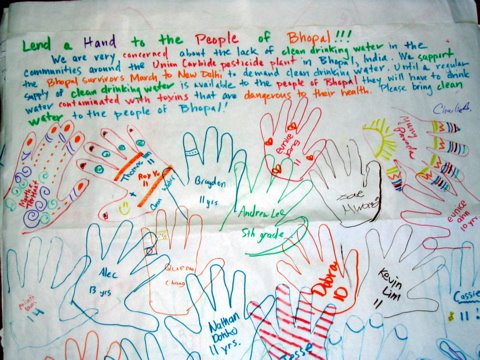
Despite the rain (we were able to move our table indoors) at the LA County Environmental Education Fair last weekend, we were able to coax 110 children to lend their handprints to our effort get clean water to the people of Bhopal. Adult petitioners came through for us as well. You haven't missed your chance! Here's the online petition: Link
This Saturday Group 22 members will once again be tabling at the Los Angeles Environmental Education Fair and we'll once again be calling attention to the campaign for justice for the people of Bhopal, India. Right now activists are marching from Bhopal to Delhi to publicize the health and environmental issues still stemming from the chemical accident in Bhopal more than 20 years ago. You can follow the marchers progress at this blog. There's a new focus and factsheet for each day as well as pictures and maps. More insights and pictures at this blog. Amnesty's part in this campaign and actions you can take to support the marchers are available here.
Ten years after Nigerian authorities executed Niger Delta writer and community activist Ken Saro-Wiwa, popular anger and unrest continue to grow, while warnings of a calamitous slide into violence abound. Saro-Wiwa campaigned for a greater share of oil wealth for the population and protested environmental damage, but little progress has been made since his death...
"Unless something drastic is done, there will not be peace around here. There's going to be trouble," prominent human rights activist Anyakwee Nsirimovu said.
With the decline in traditional occupations like fishing and farming because of environmental degradation, many young people are easily recruited into militias or crime cartels, which get their funding from oil "bunkering," or theft...
Ledum Mitee, spokesman for the Movement for the Survival of the Ogoni People, the group Saro-Wiwa founded, accused the company and its contractors of "divide and rule" tactics, bribing certain people or offering contracts to circumvent community opposition and get its work done in the region, which has half a million people and massive oil reserves. Mitee faced trial with Saro-Wiwa and is often seen as his successor.
One community chief in the Ogoni village of Kegbara Dere, Clement Goni Badom, said people were still so opposed to the company that calling someone an agent of Shell was like using a swear word.
The company said in e-mailed answers to questions from The Times that it would only return to the area if welcomed by the community. Despite the anger, the company argued, communities have turned to Shell to address poverty in the region instead of looking to the government. Shell said it had adopted a new approach across the delta region, abolishing ad hoc payments to communities or individuals to get access to sites.
Activist Nsirimovu said Shell's policies were "beautiful on paper. But those standards don't apply here."
Baakpa Birabil, 60, a farmer in Kegbara Dere, is angry that his small plot of land was destroyed in a spill two years ago. "My anger is toward Shell, who just came to my land and exploited it without leaving anything for me. You can see we are very poor people." He said people had expected good things when the oil companies first arrived, decades ago. "We never expected it would bring bad things," he said.
Today is the tenth anniversary of the execution of Ken Saro-Wiwa. How to commemorate this date? Revisit the other posts on this site about the on-going struggle of Nigerian activists to protect their environment in the face of degradation caused by the oil industry and take the recommended actions. Read Ken Wiwa's piece on his father in the Guardian (also linked on this blog), and let's let Saro-Wiwa the writer speak for himself: Sydney PEN Center has a tribute which includes a couple of his poems plus tribute poems by Ben Okri and Jack Mapanje. I used to read "The True Prison" at the end of every talk I gave for Amnesty/Sierra Club's Just Earth Network. A creation of a memorial poetry collection, Dance the Guns to Silence is part of the international effort to recognize this date, but alas the book appears to have no US publisher at this point.
Finally, how about some thoughts from a Nigerian blogger: Nigerian Times reminds us of the other martyrs to the Ogoni cause.
In November we commemorate the ten year anniversary of the execution of Nigerian author and environmentalist, Ken Saro-Wiwa by reading Ken Wiwa's moving memoir of his father, In the Shadow of a Saint. Here are a few background links:
RememberSaroWiwa is the UK-centric 10-year memorial site for KSW:
Price of Oil is a joint project of Amnesty-USA, PEN, Earthrights Intl and Sierra Club, among others. (I tried to get our discussion listed on the site, but its not showing up, at least not yet.) Be sure to check out the slideshow.


 this week (check your local PBS station for show times). PBS has a


 Our environmentally-themed novel for April,
 ,
,


 has
has 
 More
More