This month's book, American Gypsy: A Memoir by Oksana Marafioti, was an enjoyable introduction to Roma culture seen through the eyes of a young Russian immigrant. I wouldn't have minded a bit more substance on the history of the Roma people and their present day concerns, but discovering supplemental materials along those lines is just what this blog is for!
So if the history of the Roma didn't fly by fast enough for you in the book, try the fun Roma 101 video above and visit the Open Society Foundations site to learn more. For another American Roma story don't miss this story about late 19th century Hungarian immigrants.
It's hard to read a book like American Gypsy about growing up in a family of musicians and not want a soundtrack to go with it. From WGBH's Sound and Spirit, here is a program combining some historical and cultural insight into the Roma while showcasing the wide range of gypsy music:
I know some of our Loyal Readers will want to know more about the Romani language. Here are your handy links to Wikipedia and Rroma.org to satisfy your curiosity!
I'll have some film suggestions and Amnesty perspective in the next couple of days.
The 12 minute video above serves as a good intro to the book. You can also listen to Treuer discuss the book on Talk of the Nation and while you are on the NPR site follow-up with this 2008 Fresh Airinterview with this brother Anton about Ojibwe language preservation, a favorite topic here at Rights Readers. Slate also has a good audio interview about the book plus a series he wrote in 2009 about Indian casinos.
A lot of my fiction was trying to destabilize our thinking about Native people. The confidence with which people said we meant this or that. I wanted to wreck that confidence (with my novels). But with Rez Life I wanted to see what a good hard look at power would do to our ideas. Why do reservations exist? Why do we have casinos? When exactly did that happen? Why? Where and when did boarding schools exist? Why are there so many Indian kids not living with their parents? What do reservations mean? How did they get to be the way they are? So the nonfictionness of Rez Lifeis meant to help answer those questions. What can we see if we look closely? What can we see if we look carefully? What happens when I strip away all surface style? What happens to our vision then? Ironically — I think we see much more of the plurality, the multiplicity, the fecundity, the sheer range of Indian life. It isn’t one thing. Or two things. Indian life is blessedly diverse and complex and vibrant. That’s what life is after all — multiplying forms. And that, above all, is what I was trying to show: life gets bigger the more you look at it, the more you live it.
Our resident language geeks might want to check out this 2009 On Beingstory and this essay in the Washington Post. And from the NYT, here are some tips from Treuer on planning your canoe trip in Ojibwe country.
Finally, if you're curious about Treuer's fiction, you can get a taste from this reading. It had me intrigued!
We've explored the issue of endangered languages with a few books, mainly Mark Abley's Spoken Here. Travels Among Endangered Languages and Daniel Everett's Don't Sleep, There Are Snakes: Life and Language in the Amazonian Jungle, recognizing language preservation as an important part of our shared cultural heritage. I recommend taking some time out from turkey and football over the long weekend to watch We Still Live Here(via PBS Independent Lens) about the efforts of a group of Wampanoag in Massachusetts working to revive their language over 100 years after the last native speakers died. The film will add new layers to your understanding of the cultural exchange between this tribe and the Pilgrims that we celebrate at Thanksgiving. Be sure also to explore the recommended Our Mother Tonguesinteractive website, to learn more about other Native American languages.
Hey, I'm not finished with your Thanksgiving assignment yet! Another excellent documentary available for online viewing from Twin Cities Public Television, First Speakers: Exploring the Ojibwe Language was a recent Upper Midwest Emmy winner. The film is narrated by another author, and language student, we love, Louise Erdrich (Tracks). The Ojibwe have the advantage of native elders who speak their language to guide them as they seek to develop immersion curricula for their schools. Both films are fascinating!
Language buffs! Today is United Nations International Mother Language Day. On this date in 1952, students demonstrating for recognition of their language, Bangla, were shot and killed by police in Dhaka, the capital of what is now Bangladesh. Learn more here. The commemoration promotes linguistic and cultural diversity and multilingualism. If you feel like celebrating try this link
for a couple hours of linguistic and musical diversity.
This month's author, Dan Everett (Don't Sleep, There are Snakes) has his own webpage at Illinois State University, (although a note there says he has taken a position elsewhere, so the page could vanish at any moment). He does have quite a bit there to explore. This section is a good place to start. My favorite file is this song.
Here is a bit of spoken Pirahã:
As a supplement to the book, I highly recommend this New Yorker profile: The Interpreter. It will give you some idea of how others in the field of linguistics view his work. If you don't have the time for that, try this NPR profile which also contains a nice demonstration of whistle and hum speech or this Guardian profile which includes a couple sound files as well. The hardcore language buffs among our Esteemed Readers will want to check out this article and Daniel Everett/Steven Pinker exchange.
Here's a talk for courtesy of Fora.TV:
There is a documentary about Everett, it seems with no release date as yet. More info and trailer can be found here.
Updated: Fresh action today from Amnesty International:
80 members of the Guarani Kaiowá Y’poí Indigenous group in Brazil have been threatened by armed men hired by local farm owners. The group reoccupied farmland they claim as part of their ancestral territory near Paranhos, Brazil, in April. They have been threatened and being prevented from leaving their encampment. This has left them in a critical situation with no access to water, food, education and health.
The Federal Indigenous Health Agency (FUNASA) has not provided care to the community allegedly claiming this is due to lack of security. The community’s children are falling sick due to the lack of medical assistance, water and the dry weather conditions. The community has denounced their situation, but so far no action has been taken.
A riveting account of the astonishing experiences and discoveries made by linguist Daniel Everett while he lived with the Pirahã, a small tribe of Amazonian Indians in central Brazil.
Daniel Everett arrived among the Pirahã with his wife and three young children hoping to convert the tribe to Christianity. Everett quickly became obsessed with their language and its cultural and linguistic implications. The Pirahã have no counting system, no fixed terms for color, no concept of war, and no personal property. Everett was so impressed with their peaceful way of life that he eventually lost faith in the God he'd hoped to introduce to them, and instead devoted his life to the science of linguistics. Part passionate memoir, part scientific exploration, Everett's life-changing tale is riveting look into the nature of language, thought, and life itself.
Today is International Mother Language Day and I have a few suggestions for honoring endangered languages. First, you can review previous posts from our discussion of Spoken Here: Travels Among Threatened Languages by Mark Abley, where among other things you can find a link that will teach you how to greet everyone in Manx for the rest of the day. Then for something fresh you can visit UNESCO's fascinating new interactive Atlas of the World's Languages in Danger. Also, NPR reports on a new documentary, The Linguists (link opens with sound) which is set to air on some PBS stations Thursday. Looks good, though at least in my neck of the woods it's airing at midnight (fortunately I found I could save it in my Netflix queue).
Here are some general resources on endangered languages to supplement our reading of Spoken Here: First there are several organizations involved in this issue: Society for Endangered Languages, TerraLingua and the Foundation For Endangered Languages. Chicago Public Radio has an interview with the Foundation's Chairman, Nick Ostler. One thing I'll say is that these groups are very academic and their cause could really use some PR aimed at the layperson. In any case, there are some fun langauge sites to explore: Why not start translations the Universal Declaration of Human Rights? More language samples available at the Language Museum. Numbers in over 5000 languages can be found here. My favorite is a series of essays from openDemocracy on untranslatable words,
Every language has words that trigger personal truths, national histories, or cultural peculiarities; words that resonate in heart and mind as well as on the tongue. Can we translate the untranslatable?
Finally, UNESCO has a recent special issue of their newsletter the Messenger dedicated to endangered languages, and an interactive map of Africa.
Time to visit Canada on our Spoken Herejourney. Start with Omniglot's Mohawk page or links from Native American Langage Net. Here's a cool idea-- Mohawk lessons via podcast. Or visit the Kahnawake Language Center. Recommended features: Photo archive and radio, just to hear what the language sounds like. There's also a bit of Mohawk in this audio documentary about Mohawk ironworkers who worked on the World Trade Center from Lost and Found Sound.
More encounters with the endangered languages of Spoken Here. Probably, if I was capable of searching in French, we'd have better links for Provencal, but here's Omniglot's Occitan page, with orthographic comparison. Otherwise, I get a lot of dead links... not a good sign for an endangered language. I suggest going back to your Manx lessons or planning your own linguistic fieldwork (with sidetrips) in Provence.
Next stop on our Spoken Here journey is the Isle of Man and we are full of amusements! For you serious types, you can check out the Manx languageOmniglot page. But then its time to visit the Bunscoill Ghaelgagh, the Manx language primary school, and check out the pictures of Leslie Quirk. Try this site for some Manx lessons with audio, or play a little vocab game here. If you get more serious you can try the Learning Manx blog. If you just want some good visuals (or to plan your vacation) visit Manx National Heritage Web Site or Isle of Man Guide,
Continuing with our Spoken Here adventures, our visit to Oklahoma is a little thin on resources, but here's a page of Yuchi links from Native American Language Net and here's the tribe's official site.
What's a travel book without pictures? And a travel book about languages without sound? Bear with me for a series of posts related to Mark Abley's Spoken Here: Travels Among Threatened Languages that will fill in some of the audio-visual gaps. Beginning with Australia, I encourage a visit to the Postcards From Halls Creek website, poke around for pictures and give a listen to the audio program featuring voices of residents talking about their community, including some Jaru speakers. Wadeye Aboriginal Community has a similar friendly site, while the Tiwi Islands site features tempting photographs for tourists but a less personal feel.
Here's a little background on Mark Abley, author of Spoken Here: Travels Among Threatened Languages. First, a little bit of biographical information, as well as a bit about his other books, is available here. A couple of interviews are available online, one from his publisher and one from the Montreal Review of Books. He drops hints about his next book:
It's kind of a follow-up to Spoken Here. The topic is a huge one - how English and the other major languages of the world are changing, and what the future might hold for the way we speak and write.
Finally, the Foundation for Endangered Languages shares one of his poems.
Language Geek alert! I know we weren't going to let this take over the blog until November, but just felt the need to provide a few links on language in Eritrea before wrapping up our Michela Wrong-I Didn't Do It for You thread. Here's a map of Eritrean languages and Omniglot has more on Ge'ez and Tigrinya, including links to fonts for download (clean up those messy looking - ??? - Eritrean webpages!). And in the interests of pure geekiness, Omniglot also has an Interlingua page. No need to apologize if you don't recall where the book references this. You're normal. For those that did perk up at this bit of trivia, I know I'll be hearing shortly from you about the formation of a Tigrinya study group. Rock on.
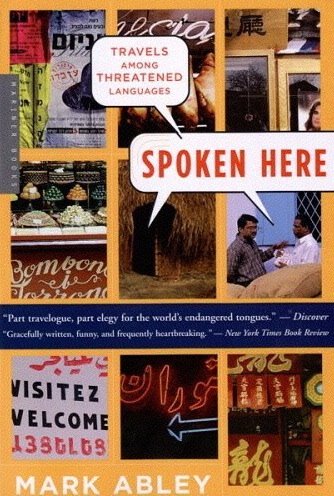
For November, we have selected Spoken Here: Travels Among Threatened Languages by Mark Abley. Apologies in advance for all the language geekiness that will no doubt follow in the wake of this decision.
Within the next couple of generations, most of the world’s 6000 languages will vanish, due mainly to the unstoppable tide of English. With an open mind and a well-worn passport, award-winning journalist and poet Mark Abley tells entertaining and vital stories about why languages matter. From Oklahoma to Provence, aboriginal Australia to Baffin Island, the cultures are radically different, but the problems of shrinking linguistic and cultural richness are painfully similar. Abley’s investigation provides a stunning glimpse of the beauty and intricacies of languages like Yiddish and Yuchi, Mohawk and Manx, Inuktitut and Provençal. More importantly, it offers a sympathetic and memorable portrait of the people who still speak languages under threat.
Just trying to give Readers a break from the usual posts about torture and genocide on this site (before we move on to nuclear disaster, ha!) In honor of one of our favorite books, Ella Minnow Pea, check out this collection of handwriting samples on Flickr and accompanying discussion of pangrams in different languages. Invitation to participate here, Pack my box with five dozen liquor jugs, anyone?
Lorraine Adams discusses the effectiveness of nonfiction books on terrorism in a 2002 Washington Monthly article by, "Terrorism and Language". Here's a taste,
The professor teaching Western Terrorism Literature 1970-2002 might open with the observation that the works of the period have their roots in The Hardy Boys adventure stories--The Sinister Signpost, The Secret Warning, While the Clock Ticked, Mystery of the Desert Giant. A common leitmotif: Only real men are capable of saving an affluent, soft society from foreign predation and apocalypse. The period's overarching theme: Terrorists are bad.
Hiding truth under abstraction was the bad writing of Orwell's day. In our day, Bergen, Emerson, Dershowitz, and Pipes hide truth under entertainment. Their books use hackneyed plotlines, stock characters, and omission of inconvenient facts. They replace the blunt actuality of terrorism with the reassuring thematics of the adventure tale, the spy thriller, the cloak-and-dagger story, even Perry Mason. Their books exhibit the symptoms that Orwell deplored--"staleness of imagery" and "lack of precision.
On the other hand, here's a recent review of a book she likes.
 This month's book, American Gypsy: A Memoir by Oksana Marafioti, was an enjoyable introduction to Roma culture seen through the eyes of a young Russian immigrant. I wouldn't have minded a bit more substance on the history of the Roma people and their present day concerns, but discovering supplemental materials along those lines is just what this blog is for!


 and Daniel Everett's
 This month's author, Dan Everett (
 ) has
) has 
 Other fun stuff:
 . Interview with author Monte Reel
  .
.


 Today is International Mother Language Day and I have a few suggestions for honoring endangered languages. First, you can review
  by Mark Abley, where among other things you can find a