Saturday, March 14, 2009

Our March Author: Edwidge Danticat

Brother, I'm Dying (Vintage Contemporaries)Let's start with a little excerpt from a 60 Minutes interview with Edwidge Danticat about her uncle's asylum case, detailed in our March book, Brother, I'm Dying.


Watch CBS Videos Online

Once you get past the obnoxious audio ad, this Washington Post slideshow, 'Faking Symptoms' -- An Asylum Seeker's Ordeal, is also a worthy visual companion to the book.

There is no shortage of interviews and one can never go wrong with NPR's Terry Gross. Even better there is this exposé of detainee medical abuse The Death of Richard Rust which also explores the Dantica case and the report Homeland Security made as followup- "a whitewash."

National Book Foundation interview,
JG: What was the hardest part of your book to write - and why was it so challenging?
ED: The hardest part was reading the government documents involved in my uncle's death.
Every encounter he had with a government official seemed so unfriendly, so distant, so cold. You have a feeling that no one was responding to him as a person, as a human being.
Democracy Now! in the wake of Danticat's testimony before a congressional committee explores the book but also draws the author out on other human rights concerns,

ED: Amy, there are actually two films now that are out on this subject that are extraordinary. One is The Price of Sugar, and one is a film called Sugar Babies that I narrate that deals with these issues. I think it’s powerful what these protesters were saying, the focus that—to focus some of the heat also on the sugar industry and the United States and the fact that actually in one of the documentaries, one of the sugar barons who actually functions here in Florida and has had a conflict with migrant labor in Florida and that are still unresolved, you know, with lack of pay—the same issues that you have with some of these bateys in the Dominican Republic. And he says something like, you know, one out of—you know, half of the sugar—he’s in every cereal box, or something to that effect, that we consume his sugar in the United States, and people may not realize that there are some subsidies that are provided to these sugar-producing families in the Dominican Republic to produce the sugar that we use here in the United States. So these issues, certainly they’re connected, the issues of migration and the fact that these children are “in transit” for their entire lives. People who have been in the Dominican Republic for fifty, sixty years are considered “in transit.” These issues and the conditions in the bateys are very important. But also it’s important for people who live here to realize, you know, it’s not disconnected from you, because this is supported by the sugar we consume here in the United States.
Foreign Policy In Focus asks Danticat what she would like to see from Obama,
Miller: What should the next president of the United States do to improve conditions with (and within) Haiti?
Danticat: I think he or she should support the leader the Haitian people have chosen for themselves and not impose U.S. choices on the people. Haiti is a very close neighbor and should not be neglected.. Aid should be given toward building infrastructure and long-term institutions so that every couple of years there is not a forced regime change that requires putting out more fires.
In lieu of an author's website, good places to explore are this compilation of NYT articles and reviews and The New Yorker has more memoir and fiction by the author online. UCSB has a wide-ranging interview and lecture here available on YouTube, probably of more interest to those who have read her fiction in addition to Brother. Danticat weighs in on the efficacy of torture, "Does It Work?" in the Washington Post.

Amnesty International details current concerns for refugees and asylum seekers here. The Dantica case has mostly disappeared from the website but here is an AIUSA statement submitted to a U.S. Senate investigating committee.

Finally, UNICEF brings a happier story out of Bel Air.

Wednesday, March 04, 2009

Response from Jarvis Jay Masters


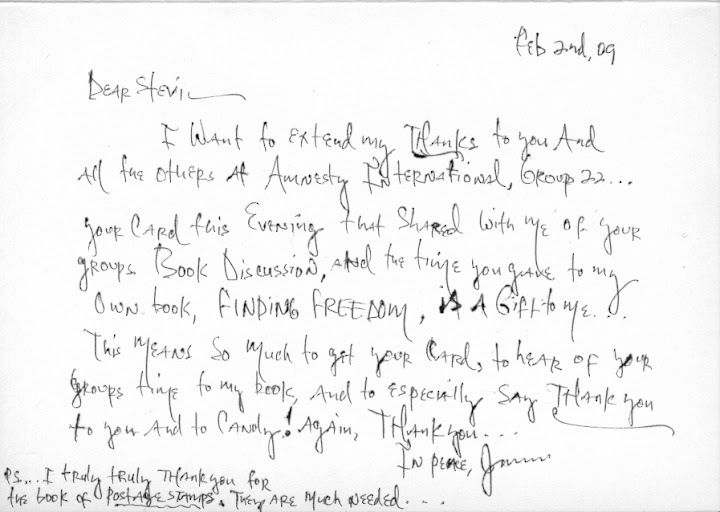
Jarvis Jay Masters sent this response to Amnesty International Group 22:
"Dear Stevi, I want to extend my thanks to you and all the others at Amnesty International Group 22. Your card this evening that shared with me of your group's book discussion, and the time you gave to my own book, Finding Freedom, is a Gift to me. This means so much to get your card, to hear of your group's time to my book, and to especially say Thank You to you and to Candy! Again, Thank you."

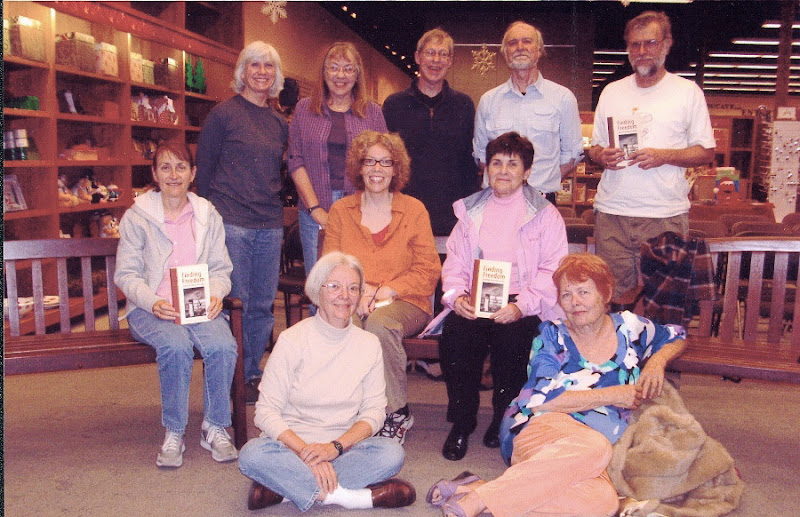
Stevi moderated the discussion of our January selection, Finding Freedom: Writings from Death Row, and gave us the opportunity to sign cards for Jarvis. She also asked our group to pose for a photo to mail to him along with the cards.
If you read Jarvis's book and are moved, as we in Rights Readers were, by the compassion and peace he has somehow managed to achieve in the soul-destroying environment of San Quentin's Death Row, you can write to him at
Jarvis Jay Masters
C35169
San Quentin State Prison
San Quentin, CA 94974

He is permitted to receive gifts of postage stamps, which he really appreciates.

Saturday, February 21, 2009

Kys t' ou? (How are you?)

Spoken Here: Travels Among Threatened LanguagesToday is International Mother Language Day and I have a few suggestions for honoring endangered languages. First, you can review previous posts from our discussion of Spoken Here: Travels Among Threatened Languages by Mark Abley, where among other things you can find a link that will teach you how to greet everyone in Manx for the rest of the day. Then for something fresh you can visit UNESCO's fascinating new interactive Atlas of the World's Languages in Danger. Also, NPR reports on a new documentary, The Linguists (link opens with sound) which is set to air on some PBS stations Thursday. Looks good, though at least in my neck of the woods it's airing at midnight (fortunately I found I could save it in my Netflix queue).

Friday, February 20, 2009

Spring Cleaning

A Problem from Hell: America and the Age of Genocide (P.S.)Lately I've accumulated a backlog of links which I should have blogged in a timely fashion so that you would have learned that Michael Ignatieff (Rights Readers selection Virtual War: Kosovo and Beyond) is now the leader of Canada's Liberal Party -- and just now has taken the opportunity of his meeting with President Obama to discuss the case of Guantanamo juvenile detainee Omar Khadr.

Or you would know that Samantha Power (A Problem from Hell: America and the Age of Genocide) has taken a position with the NSC, but before she stepped up to serve she wrote yet another profile of a human rights defender for the New Yorker (and oh yeah here's a short version of the one she wrote a whole book about.)

And then there's Arundhati Roy's (The Cost of Living) response to the Mumbai attacks, the fact that Jon Burge (a central figure in John Conroy's Unspeakable Acts, Ordinary People: The Dynamics of Torture) was arrested last fall, and Daniel Alarcon (Lost City Radio) had a New Yorker short story with a provocative title published in October.

Fortunately, this American Scholar article about Chinese censorship by Ha Jin (Ocean of Words Army Stories and The Crazed) is the sort of thing that doesn't date that fast and a little item in my local paper-- "Last month a bipartisan group of six members of Congress nominated Greg Mortenson [Three Cups of Tea] for the 2009 Nobel Peace Prize"-- might still make a you-heard-it-here-first list.

Phew! That felt good! Perhaps we'll do that again sometime, sooner rather than later.

Thursday, February 19, 2009

For June: The Cellist of Sarjevo by Steven Galloway

For June we have selected The Cellist of Sarajevo by Steven Galloway,

In a city under siege, four people whose lives have been upended are ultimately reminded of what it is to be human. From his window, a musician sees twenty-two of his friends and neighbors waiting in a breadline. Then, in a flash, they are killed by a mortar attack. In an act of defiance, the man picks up his cello and decides to play at the site of the shelling for twenty-two days, honoring their memory. Elsewhere, a young man leaves home to collect drinking water for his family and, in the face of danger, must weigh the value of generosity against selfish survivalism. A third man, older, sets off in search of bread and distraction and instead runs into a long-ago friend who reminds him of the city he thought he had lost, and the man he once was. As both men are drawn into the orbit of cello music, a fourth character—a young woman, a sniper—holds the fate of the cellist in her hands. As she protects him with her life, her own army prepares to challenge the kind of person she has become.

A novel of great intensity and power, and inspired by a true story, The Cellist of Sarajevo poignantly explores how war can change one’s definition of humanity, the effect of music on our emotional endurance, and how a romance with the rituals of daily life can itself be a form of resistance.

Anna Politkovskaya Update

Putin's Russia: Life in a Failing DemocracyThe New York Times reports reports that three men were acquitted of murdering Russian journalist Anna Politkovskaya (Rights Readers selection: Putin's Russia: Life in a Failing Democracy) CPJ responds. The Guardian has more.

Update: AIUSA responds.

Saturday, February 14, 2009

Our February Author: Louise Dean

This Human SeasonOur February author, Louise Dean (This Human Season) has her own website and here's a BBC profile. Bookbrowse has an interview,

How did you research The Human Season? Did you meet any resistance?
Over a year, a week a month in Belfast. 500 hours of taped interviews from all sides. Protestant, catholic, terrorist, mother, priest, child, prisoner, prison officers, you name it. Some prison officers were terrified of being tracked down. Most of the former terrorists were keen to tell, even if they pretended otherwise. You have to stay angry to stay alive when you've killed.
And the Guardian,
The cadences of Northern Irish speech are vivid, not just in the dialogue but, subtly, in the body of the prose, and Kathleen, in particular, is a triumph of a character. You might expect Dean to have few difficulties in articulating the feelings of a mother for her children; more startling, perhaps, is the empathy with which she creates the inner life of Dunn, a man of principle but limited education now living under the shadow of retaliatory attacks from the IRA. 'I showed drafts of the book to some of the people I'd interviewed and become close to so that they could point out any inconsistencies,' Dean says, 'and perhaps the greatest compliment I've ever had was for one of the Catholic women to say she'd never seen it from the officers' point of view until she read the book.'
Speaking of research, one of our Esteemed Readers passed on the Wikipedia link on Maze Prison and I found this BBC timeline helpful. Some lyrics to some prison songs can be found here. I know I felt a larger glossary for the book wouldn't have hurt and Esteemed Blogger Joyce came to my rescue with this.

For some very recent news about how the reconciliation is going in Northern Ireland check out these posts at Chasing The Flame and Talking Rights.
Related Posts Plugin for WordPress, Blogger...