Showing posts with label Prisons. Show all posts

Tuesday, November 13, 2012

Intro to Stasiland


This month we are reading Stasiland: Stories from Behind the Berlin Wall by Anna Funder. The book explores the psychological legacy of the communist-era East German state security apparatus. The Australian video above is a great way to get started with the topic, introducing you to a couple of unrepentant Stasi officers, visiting Stasi headquarters and taking you on a tour of the Stasi prison, Hohenschönhausen, led by a former inmate. Anna Funder provides insight along the way. To hear another inmate tell his story, including how Shakespeare helped him through his ordeal, see this PBS Newshour slide show. More discussion (and photos) of the work of the prison museum is available from Wired. Stay tuned for more on the book in the next few days.

Thursday, July 12, 2012

Our July Author: Avi Steinberg

This month we are discussing Avi Steinberg's Running the Books, a memoir about the adventures of a prison librarian. Although I had some concern about being 'trapped' in a book about prisons in July, a month when I usually try to propose travel books, I really enjoyed this journey.  We've got a few links to get things rolling, starting with his personal website: avisteinberg.com.  Because the book contains quite a bit of the author's backstory, the usual interviews don't reveal a whole lot more than you learn in the book, but if you haven't read it yet and need a shortcut to prepare for the meeting, start here. I learned of the book from this NPR interview.  This profile from Harvard magazine is also a good introduction,
Any assumptions about the ease of book learning quickly disappeared. “As a prison librarian, you need to fight for the space, fight to purchase the books, fight to keep books on the shelves, fight for people to be able to come to the library, fight to keep people coming back to the library,” Steinberg says of his daily struggles. “It takes a lot of effort to bring books alive for people. To me, this was not obvious before.”
For those that have read the book and want more, Steinberg has been writing on a variety of (often amusing) subjects for publications like the Paris Review and The New Yorker. Check out this video if you want a preview of his next book. And you definitely want to check out this piece from Huffpo: Conversations with a Young Islamist in the Prison Library,
I can honestly say that if Akh did become a radical Islamist in prison it was despite the education he received in the prison library. It is just as likely that our conversations--simply the example of an open and respectful dialogue--planted a seed. It was, after all, a kind of tolerance that kept him coming back enthusiastically to the prison library and that kept our conversations honest and alive. In prison, and even in the balkanized world at large, this alone is a rare achievement.
Of course, we've covered some of this territory before. I was happy to see that Ted Conover's Newjack: Guarding Sing Sing got a nod from the author. We read the book a while back (along with two others by the author, making Conover Rights Readers' all-time favorite author) and recommend it if you enjoyed Running. You may be interested to learn that New Jack is still contraband in the New York prison system, but the author wrote recently about his first return visit to Sing Sing to see an inmate-produced play and he testifies to the role of theater in envisioning alternative roles as a part of rehabilitation. Huffpo also has a good interview with Conover. By the way, Ted Conover is not the only author we've read whose books have been banned behind bars. I linked to this once before, but I recommend this video of Toni Morrison and Angela Davis discussing the value of prison libraries and problems with censors.  The Austin Statesman has a fascinating report on books and authors banned in Texas prisons, including Edwidge Danticat. I also liked this article about a lawsuit filed by the always inspiring Bryan Stevenson of the Equal Justice Initiative on behalf of an Alabama inmate who was banned from reading the Pulitzer Prize winning book Slavery by Another Name

Take a look at this birds-eye view of the U.S. prison-industrial complex. There's a prison near you. If you've got some books you'd like to donate to a prison, this looks like a good place to start. If you want to learn more about prison issues, Slate has a round-up of some excellent investigative journalism on the subject. If you're in favor of more books, more dialog, better libraries, and better rehabilitation programs, you'll want to join the growing campaign to rethink the practice of solitary confinement.  Take action on behalf of the "Angola 3' here. See also the recent action against conditions at TAMMS Supermax prison in Illinois. More info/action from Solitary Watch. There's a lot of work to be done!

Tuesday, June 26, 2012

Arizona Repercussions

Yesterday, Amnesty International responded to the U.S. Supreme Court decision in the Arizona immigration enforcement case welcoming the provisions that were overturned but referring to the provision that requires law enforcement officers to determine the immigration status of anyone who has been stopped for questioning when there’s reasonable suspicion that the person is in the country illegally, warned,
we are disappointed that the Court failed to draw a clearer line in the sand against racial profiling. This leaves the door open for continued challenges as ambiguities in implementation still exist.
So who is going to ensure going forward that racial profiling does not occur? Our old friend Sheriff Joe Arpaio! We've campaigned before on the horrendous conditions at the 'tent city' prison he has created in Phoenix and former Executive Director of Amnesty, William Schulz debated the sheriff on at least a couple of occasions. As it happens, Bill was back in town just a few days ago leading fellow Unitarians in an impressive vigil outside Tent City.  Radio station KFYI reports,
William Schulz, president and CEO of the Unitarian Universalist Service Committee and former head of Amnesty International in the U.S., said, "International standards for the treatment of prisoners are simple and straighforward when it comes to the question of prolonged exposure to heat.  This is clearly a violation of those standards."
Schulz said when he was with Amnesty International, he saw prisons in countries around the world, and the conditions at Tent City are nearly as bad as some of the worst he has seen.  Sheriff Arpaio objected, "Don't ever compare my jails with those countries.  That's an insult."
After the Supreme Court ruling, Sheriff Joe, who is also currently targeted in a Justice Department lawsuit, was unrepentant in his response to the Arizona ruling. Arpaio was also one of the guests on KPCC's Air Talk coverage of the ruling yesterday.

It's good to see the Rev. Schulz still on the case. We enjoyed reading a couple of his books. Looks like he's written a few more. Check them out here.

Wednesday, March 04, 2009

Response from Jarvis Jay Masters


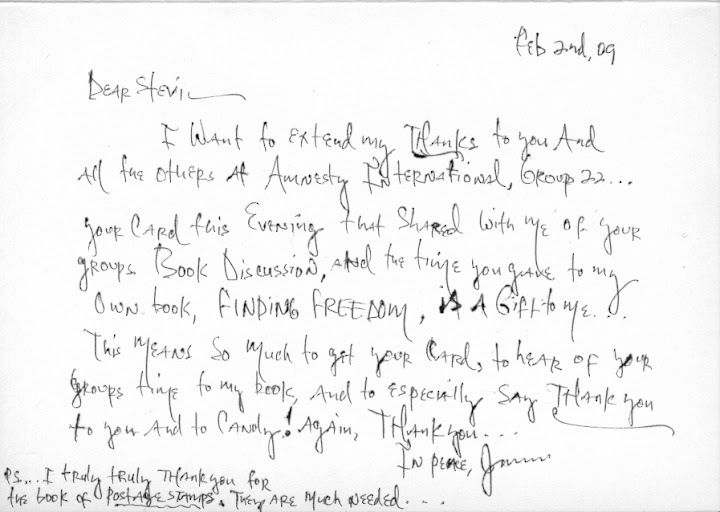
Jarvis Jay Masters sent this response to Amnesty International Group 22:
"Dear Stevi, I want to extend my thanks to you and all the others at Amnesty International Group 22. Your card this evening that shared with me of your group's book discussion, and the time you gave to my own book, Finding Freedom, is a Gift to me. This means so much to get your card, to hear of your group's time to my book, and to especially say Thank You to you and to Candy! Again, Thank you."

Stevi moderated the discussion of our January selection, Finding Freedom: Writings from Death Row, and gave us the opportunity to sign cards for Jarvis. She also asked our group to pose for a photo to mail to him along with the cards.
If you read Jarvis's book and are moved, as we in Rights Readers were, by the compassion and peace he has somehow managed to achieve in the soul-destroying environment of San Quentin's Death Row, you can write to him at
Jarvis Jay Masters
C35169
San Quentin State Prison
San Quentin, CA 94974

He is permitted to receive gifts of postage stamps, which he really appreciates.

Saturday, January 17, 2009

Johnny Cash - San Quentin

A bonus post for our January book Finding Freedom: Writings from Death Row by Jarvis Jay Masters: Johnny Cash performs San Quentin at San Quentin:


Worth it for the glimpses of San Quentin in 1969. If you enjoyed that, here's Folsom Prison Blues and I Walk the Line from the same concert.

Our January Author: Jarvis Jay Masters

The first stop to supplement your reading of Finding Freedom: Writings from Death Row by Jarvis Jay Masters, must be his support committee's website: freejarvis.org particularly the material they have explaining the current status of his appeal.

The California Department of Corrections and Rehabilitation provides this site with overview and stats on San Quentin. The department provides a set of pictures of death row, as well. Marin County provides us with a fascinating San Quentin photo album from its historical archives. Hulu.com has full espisodes from the MSNBC series Lockup, including Inside San Quentin. It's very guard-centric and focused on the sensational, but it's one way to get inside and look around.

San Quentin in the news: Don't miss this July 2008 NPR report (with illustrative photography) of the overcrowding at San Quentin. Then there is former warden Jeanne Woodford's LAT editorial from October 2008,
I worked in corrections for 30 years, starting as a correctional officer and working my way up to warden at San Quentin and then on to the top job in the state -- director of the California Department of Corrections and Rehabilitation. During those years, I came to believe that the death penalty should be replaced with life without the possibility of parole.
The police chief of Newark, CA has also recently expressed concerns that the death penalty hurts public safety and his budget concerns are echoed by at least a couple of California lawmakers.

Under the direction of writer Tobias Wolff, San Quentin has recently revived its prisoner produced newsletter. Copies can be downloaded here. Highly recommended! Of course this reminds me of another favorite book of mine, Life Sentences: Rage and Survival Behind Bars, by Ron Wikberg and Wilbert Rideau, which is sadly out of print, but worth a look in your library. It contains articles from the Angolite, the newspaper of Angola prison in Louisiana. Samples of Rideau's writing can be found here. Other sources for prison writing include PEN American Center's Prison Writing Program and this Canadian site contains links to the writing and art work of more California death row inmates.

Tuesday, October 14, 2008

For January: Finding Freedom by Jarvis Jay Masters

For January, we have chosen Finding Freedom: Writings from Death Row by California death row inmate Jarvis Jay Masters:
Finding Freedom is a collection of prison stories - sometimes shocking, sometimes sad, often funny, always immediate-told against a background of extreme violence and aggression, written by a prisoner on death row who has become a practitioner of Tibetan Buddhism.

Monday, March 19, 2007

Finding Freedom

A brief follow-up to our non-virtual discussion yesterday: The San Francisco Chronicle reports on good news in the case of California death row inmate Jarvis Jay Masters (author of possible future Rights Readers selection Finding Freedom),

The California Supreme Court, in an unusual step, has ordered state prosecutors to respond to defense lawyers' claims that new evidence shows a San Quentin State Prison inmate is innocent of the 1985 murder of a prison guard that sent him to Death Row.

Jarvis Masters' appeal is still a longshot in a court that upholds more than 90 percent of the death sentences it considers. But the circumstances of the Feb. 14 order signed by all seven justices have given Masters' lawyers a glimmer of hope that their 45-year-old client will be vindicated.

Saturday, August 05, 2006

Prison Art from M&Ms

I'm a bit late with this but I meant to recommend NPR's recent series on Life in Solitary Confinement. In addition to the audio series, much of it focusing on California's "supermax" prison at Pelican Bay, there are some "web extras" including an interview with Human Rights Watch's Jamie Fellner on the human rights implications of indefinite solitary confinement.

The art teacher in me was drawn to today's Los Angeles Times which tells us that a Pelican Bay inmate, Donny Johnson, who paints with dyes made from M&Ms, faces disciplinary action because he's been allowing his work to be sold to benefit a charity, Pelican Bay Prison Project, that supports children of prisoners. The New York Times has a profile of the artist, with a slideshow, also linked via this article. (A couple of images are also on view at CNN.) Very vibrant! So much for "melts in your mouth not in your hands!" Pelican Bay Prison Project's site also has some columns written by Donny.

Tags: , ,

Wednesday, March 08, 2006

For Women's Day: Too Much Time

In honor of International Women's Day I'd like to highlight Amnesty's new report Abuse of Women in Custody: Sexual Misconduct and Shackling of Pregnant. The report surveys laws, policies and practices in all 50 states, the District of Columbia and the U.S. Bureau of Prisons regarding custodial sexual misconduct and the shackling of inmates who are pregnant or giving birth. If the report is too dry for you, skip to the multimedia presentation, Too Much Time, featuring the photography of Jane Evelyn Atwood and if you're short on time, skip the intro and go to part two of the presentation and just view the photos and listen to the commentary on "Vanessa's Baby." California residents can breathe a sigh of relief that our legislature just passed a law barring the shackling of women in labor, but its just appalling that it took this long... or that it would be necessary in the first place! Note: Atwood's photojournalism is also available in book form- Too Much Time: Women in Prison

Wednesday, October 26, 2005

Sister Janet's Juvenile Justice Initiative

NO MATTER HOW LOUD I SHOUT : A Year in the Life of Juvenile CourtToday's Los Angeles Times Column One feature is an article about Central Juvenile Hall's Sister Janet Harris and her crusade for a young man she took note of in the detention center's writing program. This should ring bells for our long-time readers who remember one of our favorite books, Edward Humes' No Matter How Loud I Shout. The article points up the legacy of Prop 21 (recall our candlelight vigil outside Juvenile Hall?) and cites Amnesty's recent report The Rest of Their Lives: Life Without Parole for Child Offenders in the United States. From the article:
An initiative passed in 2000 by 62% of California voters gave district attorneys the power to determine whether juveniles accused of certain serious crimes should face adult punishment.

The most severe sentence that can be imposed in Juvenile Court is detention until age 25. Had Rocha not been tried as an adult, his supporters say, he might have been freed by now.

Last year, the Los Angeles County district attorney's office filed 178 juvenile cases in adult court, and 119 juveniles were transferred to adult court after judicial hearings, according to the agency's statistics.

A report published Oct. 12 by Amnesty International and Human Rights Watch found that 2,225 offenders are serving life without parole in U.S. prisons for crimes committed before they turned 18. For an estimated 59% of those inmates, it was their first conviction.

The U.S. is one of only a few countries that allow children to be imprisoned for life without parole. Elsewhere in the world, about 12 young offenders are currently serving such sentences, the study found.
By the way, Edward Humes has a website if you're curious what he's been up to lately.

Related Posts Plugin for WordPress, Blogger...