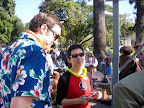
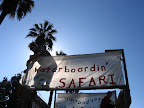
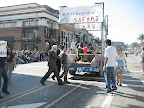
Team Doodah. Photos from Stevi.
Video from Katerina. Action! Sound!
Katerina's Doodah Album. More photos and videos.
Dan's Album. Dramatic waterboarding shots, as seen from the driver's seat.
Paul's Album. Some nice closeups of participants.
Team Doodah. Photos from Stevi.
Video from Katerina. Action! Sound!
Katerina's Doodah Album. More photos and videos.
Dan's Album. Dramatic waterboarding shots, as seen from the driver's seat.
Paul's Album. Some nice closeups of participants.
For May we have selected Banker to the Poor:Microlending and the battle against world poverty by Nobel Peace Prize winner Muhammad Yunus:Muhammad Yunus is that rare thing: a bona fide visionary. His dream is the total eradication of poverty from the world. In 1983, against the advice of banking and government officials, Yunus established Grameen, a bank devoted to providing the poorest of Bangladesh with minuscule loans. Grameen Bank, based on the belief that credit is a basic human right, not the privilege of a fortunate few, now provides over 2.5 billion dollars of micro-loans to more than two million families in rural Bangladesh. Ninety-four percent of Yunus's clients are women, and repayment rates are near 100 percent. Around the world, micro-lending programs inspired by Grameen are blossoming, with more than three hundred programs established in the United States alone.Banker to the Poor is Muhammad Yunus's memoir of how he decided to change his life in order to help the world's poor. In it he traces the intellectual and spiritual journey that led him to fundamentally rethink the economic relationship between rich and poor, and the challenges he and his colleagues faced in founding Grameen. He also provides wise, hopeful guidance for anyone who would like to join him in "putting homelessness and destitution in a museum so that one day our children will visit it and ask how we could have allowed such a terrible thing to go on for so long." The definitive history of micro-credit direct from the man that conceived of it, Banker to the Poor is necessary and inspirational reading for anyone interested in economics, public policy, philanthropy, social history, and business.
Muhammad Yunus was born in Bangladesh and earned his Ph.D. in economics in the United States at Vanderbilt University, where he was deeply influenced by the civil rights movement. He still lives in Bangladesh, and travels widely around the world on behalf of Grameen Bank and the concept of micro-credit.
Doo Dah Parade!
Our local group of Amnesty International joined with some friends, mostly from the Caltech community, to participate in the 31st Occasional Pasadena Doo Dah parade, which was held on Sunday, January 20th, in Old Town Pasadena. Taking advantage of the availability of a truck (and a bathtub) that we could transform into a float, we decided to address the serious issue of waterboarding. We came up with a little scenario in which we welcomed the crowd to “
Bob Dylan has been a huge influence on my writing. He knows how to tell a whole story in just a few minutes and he has a wonderful way with words. Of course, the guy can’t sing, but you can’t have everything.OK, not really seeing the Dylan connection in Snow Flower, heh, but not knocking the insight-- and looking ahead to her next book check out this interview at the The Elegant Variation,
The new novel’s tentatively called Shanghai Girls. It starts in 1937 with two sisters in Shanghai. They come to Los Angeles in arranged marriages. (We often read about arranged marriages in other countries, but a lot of people don’t know that we had and still have them here in the U.S.) They live in a place called China City, which was built from the leftover sets from the filming of “The Good Earth.” So in some ways Shanghai Girls will be an exploration of what it means to be Chinese or American, and what is real and what is just façade. I’ll also be looking at the Confession Program, which took place in the 1950s, when the U.S. government targeted Chinese to try to get them to confess that they were here illegally and at the same time rat out their friends, family members, and neighbors as being Communists.I wasn't much interested in the discussion of footbinding in the book, but NPR and the BBC both have good backgrounders. I was more obsessed with the discussion of nushu. World of Nushu has a wealth of information, including pictures from Jian Yong Prefecture. Omniglot and Ancient Scripts have some nice side by side comparisons with Chinese and this article may be a bit academic for some, but it answered some of my questions about how nushu functioned in women's society.
For April, we have selected Dinaw Mengestu's The Beautiful Things that Heaven Bears,Seventeen years ago, Sepha Stephanos fled the Ethiopian Revolution for a new start in the United States. Now he finds himself running a failing grocery store in a poor African-American section of Washington, D.C., his only companions two fellow African immigrants who share his bitter nostalgia and longing for his home continent. Years ago and worlds away Sepha could never have imagined a life of such isolation. As his environment begins to change, hope comes in the form of a friendship with new neighbors Judith and Naomi, a white woman and her biracial daughter. But when a series of racial incidents disturbs the community, Sepha may lose everything all over again.
Eritrean journalist Seyoum Tsehaye has been chosen as “Journalist of the Year 2007” by Reporters Without Borders - Fondation de France. The panel of judges sought to highlight not only the case of this brave journalist held in Eritrea’s appalling jails since September 2001 but also the catastrophic state of press freedom in this small Horn of Africa country. At least four journalists have died in prison in Eritrea over the last few years. The blame lies chiefly at the door of Issaias Afeworki, the highly authoritarian and obdurate president of the country since its independence in 1993.Read the full press release from Reporters Without Borders here.
For those who would like a little contextual background and visual stimulus, here's an exhibition of Moscow Samizdat books and another of vintage Soviet propaganda posters.If the book, From Newbury With Love, evokes the lost worlds of the Cold War, it's also a reminder of an era when people wrote each other letters, rather than e-mails and texts.
And Marina says she regrets the lost pleasures of the letter.
"You looked at the stamp, you opened the letter, you smelt it. First, you read it very quickly, and then in the evening, when the children were in bed, my mum would take a glass of wine, light a cigarette and read and re-read and really enjoy the letter. It's physical, you see their handwriting, you keep the letters."