Recently I've stumbled on some films that seem like good backgrounders for a few of the books we've read. I recently rented the HBO film, Bury My Heart at Wounded Knee, a nice historical companion piece for the Louise Erdrich novel, Tracks, we read not long ago. For something completely different, there is Ten Canoes, an Australian fable told partially in an aboriginal tongue which brought me back to Spoken Here: Travels Among Threatened Languages. Unrelated to any reading we've done but providing a backdrop to our work on China and globalization there is the oddly beautiful and meditative documentary about the photographer Edward Burtynsky, Manufactured Landscapes. Last but not least, I am looking forward (next up in my queue) to viewing the film version of our February book The Yacoubian Building. Trailer (with the cheesiest voiceover ever) below:
Friday, February 15, 2008


Greetings from Wisconsin!
 Most Loyal Readers know already that their Leader Reader has departed California for Wisconsin. Here's a little update on my reading exploits since moving here:
Apart from venturing into a community book discussion group, I arrived just in time for River Falls Reads 2008 and attended the kick-off event featuring Jerene Mortenson, the mother of Greg Mortenson, author of Rights Readers selection Three Cups of Tea. As noted before, River Falls is the birthplace of "Pennies for Peace", a program that educates American children about the world beyond their experience and raises funds for schools in Central Asia. A few things I learned from the talk: that there are over 400 U.S. schools now in the program, and that pennies were chosen to make sure children of all incomes could participate. I was also intrigued to learn that storytelling is part of the curriculum for students in Pakistan, thus incorporating the elders of the village and the oral tradition into the schools. I would love to hear some of those stories! My California readers will also be heartened to learn that steps are being taken to build new schools that are designed to better withstand earthquakes. The rest of the River Falls Reads event line-up looks interesting as well. Small towns have a lot to offer! I am sure I will have more reading adventures to share in the future...
Tuesday, February 12, 2008
Blogging Human Rights in Egypt
I've just finished reading our February book selection, The Yacoubian Building. A recent article in the Los Angeles Times about Egyptian blogger Wael Abbas addressed many of the human rights issues that this novel deals with.
You can read the entire LA Times article here. Here is a YouTube video of Wael Abbas accepting an award from the International Center For Journalists. Once you're at YouTube, you can search for and view other Wael Abbas videos.DISPATCH FROM CAIROBy Jeffrey Fleishman, Los Angeles Times Staff Writer CAIRO -- It was not the most comforting of e-mails: "May God honor my sword by slaying Wael Abbas." Cyberspace can be a messy, dangerous place, especially if you're Abbas, who with keyboard, digital camera and a bit of cunning has become one of Egypt's most popular bloggers. His posts, often with scratchy video, catalog police torture, political oppression, labor strikes, sexual harassment and radical Islam. He's been vilified and threatened, but has managed to stay out of jail, operating in an uncensored realm beyond the independent and state-controlled media. ... Abbas' most dramatic blog posts are videos, some shot with cellphone cameras, depicting police brutality, which has long been a concern in this country of 80 million people. In 2007, Abbas gained international attention when he posted images of police officers sodomizing a bus driver with a stick. The driver had committed no crime, and the courts, forced to react to irrefutable evidence and public anger, sentenced two police officers each to three years in prison.
In Egypt, high-risk blogging
Sunday, January 27, 2008
Photos from Doodah Parade
Here are links to photo albums from Group 22's entry in the Pasadena Doodah Parade. Click on an image to view album or video.
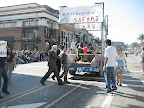
Team Doodah. Photos from Stevi.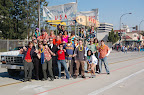
Video from Katerina. Action! Sound!
Katerina's Doodah Album. More photos and videos.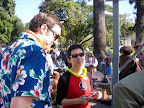
Dan's Album. Dramatic waterboarding shots, as seen from the driver's seat.
Paul's Album. Some nice closeups of participants.
Joyce's Album.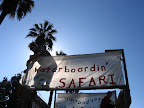
For May: Banker to the Poor by Muhammad Yunus
 For May we have selected Banker to the Poor:Microlending and the battle against world poverty by Nobel Peace Prize winner Muhammad Yunus:
Muhammad Yunus is that rare thing: a bona fide visionary. His dream is the total eradication of poverty from the world. In 1983, against the advice of banking and government officials, Yunus established Grameen, a bank devoted to providing the poorest of Bangladesh with minuscule loans. Grameen Bank, based on the belief that credit is a basic human right, not the privilege of a fortunate few, now provides over 2.5 billion dollars of micro-loans to more than two million families in rural Bangladesh. Ninety-four percent of Yunus's clients are women, and repayment rates are near 100 percent. Around the world, micro-lending programs inspired by Grameen are blossoming, with more than three hundred programs established in the United States alone.Banker to the Poor is Muhammad Yunus's memoir of how he decided to change his life in order to help the world's poor. In it he traces the intellectual and spiritual journey that led him to fundamentally rethink the economic relationship between rich and poor, and the challenges he and his colleagues faced in founding Grameen. He also provides wise, hopeful guidance for anyone who would like to join him in "putting homelessness and destitution in a museum so that one day our children will visit it and ask how we could have allowed such a terrible thing to go on for so long." The definitive history of micro-credit direct from the man that conceived of it, Banker to the Poor is necessary and inspirational reading for anyone interested in economics, public policy, philanthropy, social history, and business.
Muhammad Yunus was born in Bangladesh and earned his Ph.D. in economics in the United States at Vanderbilt University, where he was deeply influenced by the civil rights movement. He still lives in Bangladesh, and travels widely around the world on behalf of Grameen Bank and the concept of micro-credit.
Tuesday, January 22, 2008
Doo Dah Parade
Doo Dah Parade!
Our local group of Amnesty International joined with some friends, mostly from the Caltech community, to participate in the 31st Occasional Pasadena Doo Dah parade, which was held on Sunday, January 20th, in Old Town Pasadena. Taking advantage of the availability of a truck (and a bathtub) that we could transform into a float, we decided to address the serious issue of waterboarding. We came up with a little scenario in which we welcomed the crowd to “
Saturday, January 19, 2008
Our January Author: Lisa See
Lisa See, the author of this month's book, Snow Flower and the Secret Fan, has her own website, LisaSee.com (be sure to check out the Events section for an up-coming San Marino event!). Bloomsbury.com offers an article by See about her interest in nushu and an audio interview with the author is available here. Another interview with odd bits can be found at WaterBridge,
Bob Dylan has been a huge influence on my writing. He knows how to tell a whole story in just a few minutes and he has a wonderful way with words. Of course, the guy can’t sing, but you can’t have everything.OK, not really seeing the Dylan connection in Snow Flower, heh, but not knocking the insight-- and looking ahead to her next book check out this interview at the The Elegant Variation,
The new novel’s tentatively called Shanghai Girls. It starts in 1937 with two sisters in Shanghai. They come to Los Angeles in arranged marriages. (We often read about arranged marriages in other countries, but a lot of people don’t know that we had and still have them here in the U.S.) They live in a place called China City, which was built from the leftover sets from the filming of “The Good Earth.” So in some ways Shanghai Girls will be an exploration of what it means to be Chinese or American, and what is real and what is just façade. I’ll also be looking at the Confession Program, which took place in the 1950s, when the U.S. government targeted Chinese to try to get them to confess that they were here illegally and at the same time rat out their friends, family members, and neighbors as being Communists.I wasn't much interested in the discussion of footbinding in the book, but NPR and the BBC both have good backgrounders. I was more obsessed with the discussion of nushu. World of Nushu has a wealth of information, including pictures from Jian Yong Prefecture. Omniglot and Ancient Scripts have some nice side by side comparisons with Chinese and this article may be a bit academic for some, but it answered some of my questions about how nushu functioned in women's society.
Subscribe to:
Posts (Atom)
